Learning and Successfully Implementing OKR – with OKR CARDS
Share
Table of Contents:
1. Introduction: Why OKRs are Crucial for Businesses
2. What does OKR mean? Origin and Benefits of the Framework
3. Typical Hurdles in OKR Implementation and Their Causes
4. The OKR Cards: Your Practical Companion for Learning OKRs
5. How to Learn OKRs with OKR Cards: A Practical Introduction
6. Successful OKR Implementation: Strategies and Proven Approaches
7. Best Practices and Common Mistakes: Learning from Experience
8. Conclusion: Achieving Sustainable Business Success with OKR Cards
-----
1. Introduction: Why OKRs are Crucial for Businesses
In an era where businesses must remain agile to compete, clear goals and measurable results are indispensable. Objectives and Key Results (OKRs) have established themselves as an effective framework for promoting strategic alignment and focusing on what truly matters. Companies like Google and LinkedIn have demonstrated how OKRs help achieve ambitious goals.
However, implementing OKRs is often challenging. Many teams struggle to familiarize themselves with the methodology or integrate it sustainably into their daily work. Lack of training, unclear formulations, and an inadequate goal structure frequently lead to frustration.
2. What does OKR mean? Origin and Benefits of the Framework
OKRs consist of Objectives and Key Results. Objectives describe inspiring, high-quality goals, while Key Results measure progress using quantifiable indicators. The framework was developed at Intel in the 1970s and later adopted by Google, contributing to its global spread.
The biggest advantage of OKRs lies in their simplicity and scalability. They help companies focus on essentials, clearly set priorities, and make progress visible. At the same time, they promote transparency and alignment, as all employees pursue the same goals.
Moreover, OKRs foster a culture of continuous improvement. Through regular reviews and adjustments, successes are celebrated, and failures are used as learning opportunities. Thus, OKRs contribute sustainably to business development.
3. Typical Hurdles in OKR Implementation and Their Causes
Many companies fail at implementing OKRs because they underestimate the complexity of the framework. A common mistake is setting too many goals simultaneously, which overwhelms teams and dilutes focus. Unclear formulations and missing measurement criteria make it difficult to assess success.
Another hurdle is a lack of understanding of the framework. If teams don't grasp the meaning of Key Results or the role of regular check-ins, the full potential of OKRs remains untapped. This often stems from a lack of suitable training materials and clear examples.
The lack of involvement from leadership is also problematic. If executives don't exemplify and actively use OKRs, the framework loses significance. Successful implementation therefore requires clear communication, top-down support, and a practical introduction method.
4. The OKR Cards: Your Practical Companion for Learning OKRs
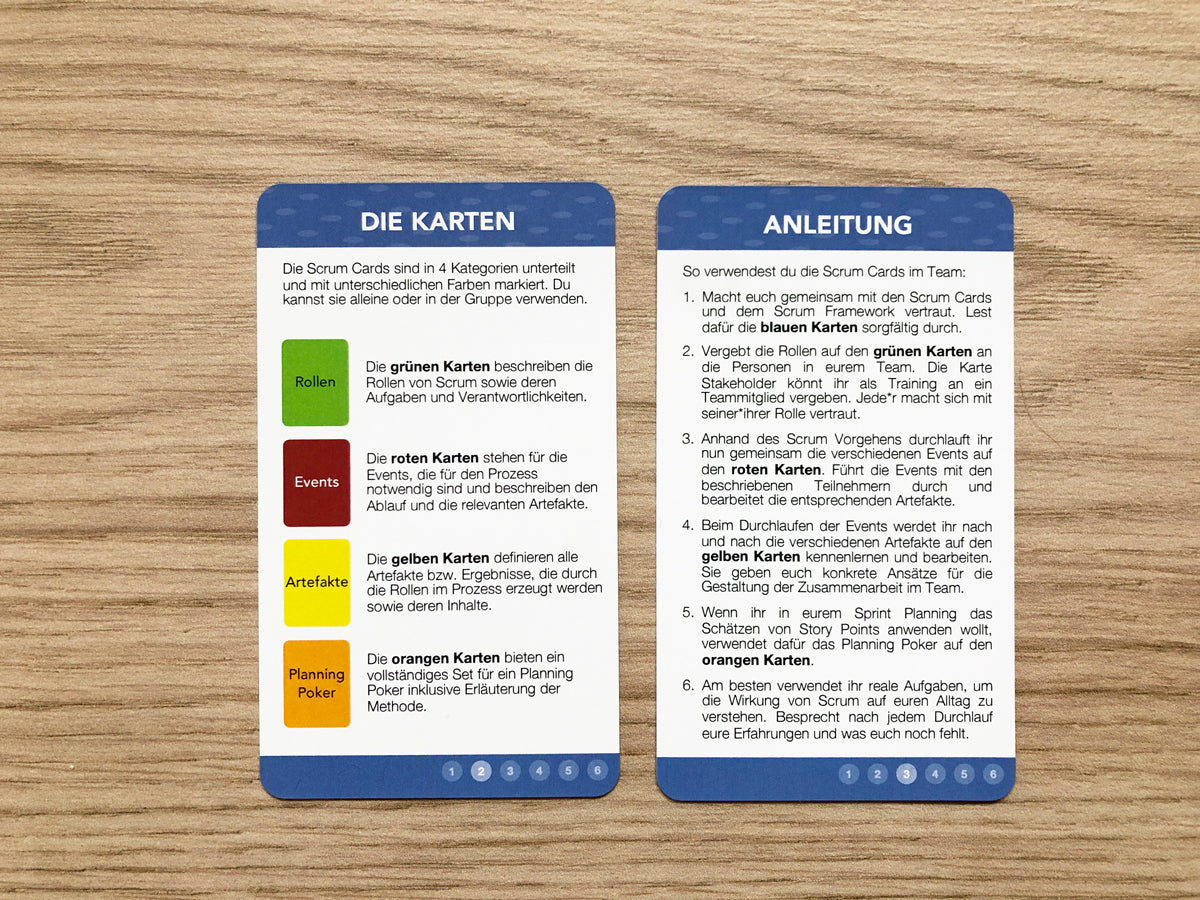
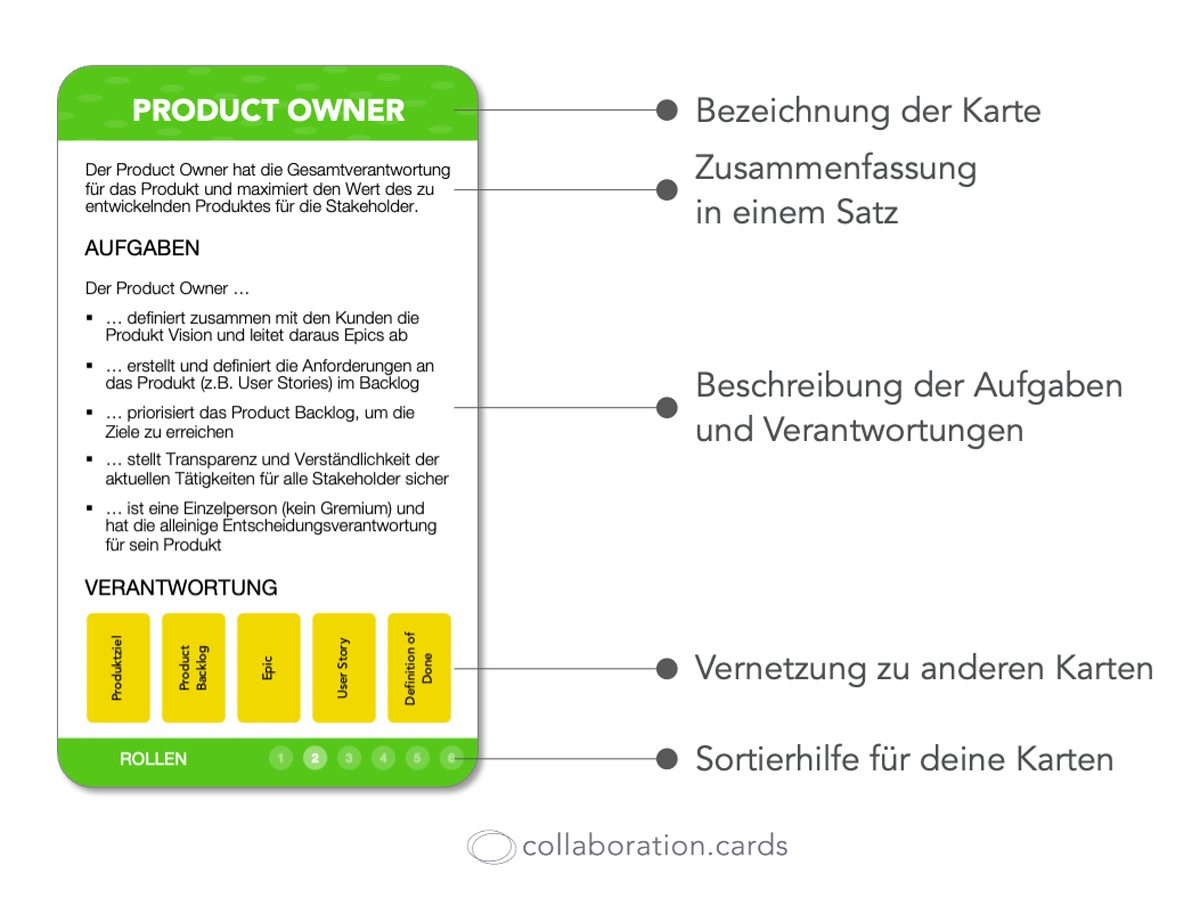
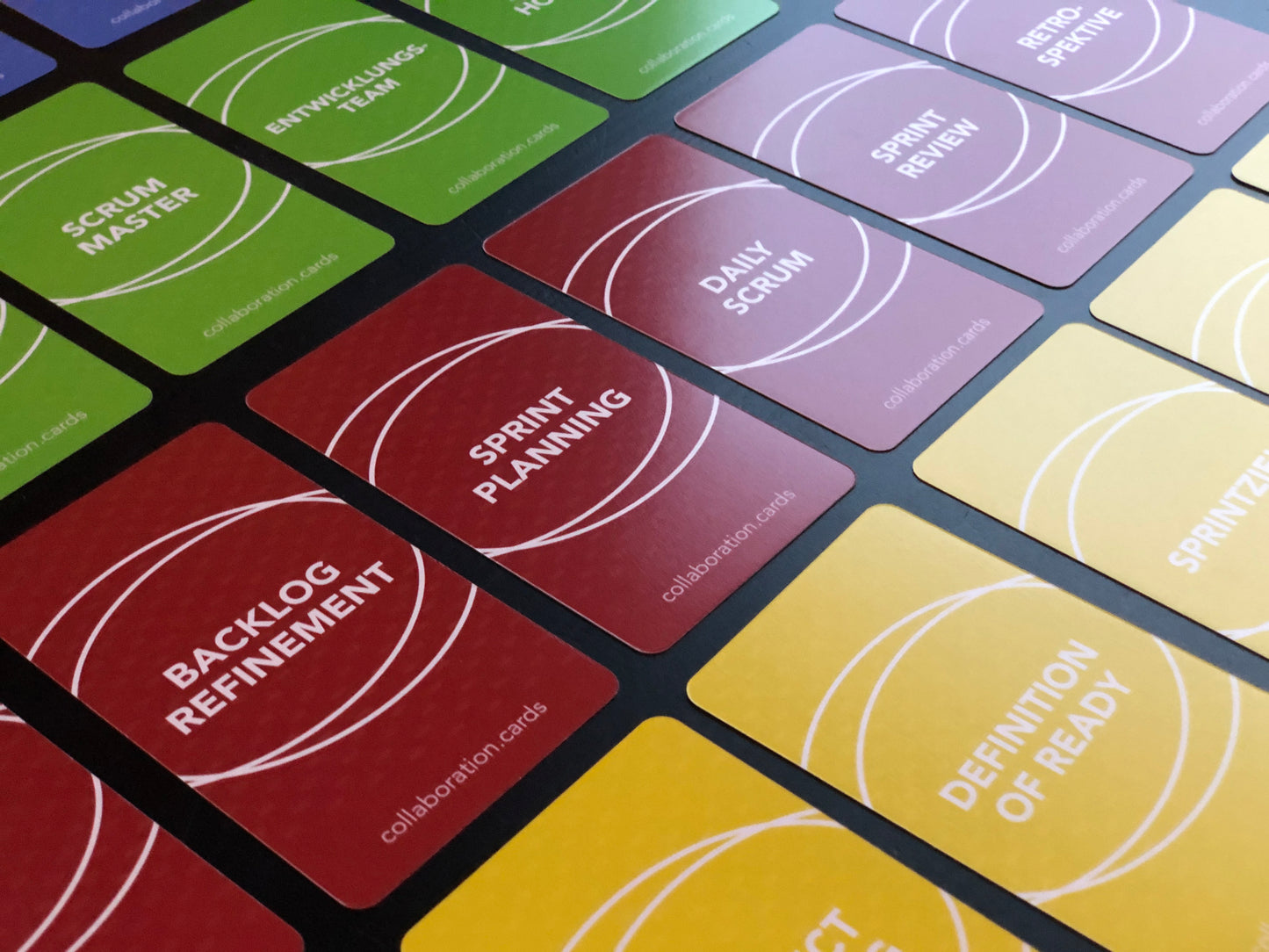
The OKR Cards from Collaboration Cards are an effective tool for conveying the OKR framework in a clear and practical way. They consist of 32 high-quality designed cards that concisely explain the most important OKR concepts, roles, and processes. Their visual presentation makes them easy to understand and suitable for teams of all experience levels.
The cards are particularly well-suited for interactive workshops and team training. They help clarify technical terms, define roles, and discuss examples of good Objectives and Key Results. This promotes dialogue and strengthens a shared understanding of the framework.
Furthermore, the OKR Cards serve as a reference tool in daily work. Teams can use the cards during their weekly check-ins to remember the basics, structure discussions, or reflect on their progress. This makes the cards a valuable companion on the path to a successful OKR culture.
5. How to Learn OKRs with OKR Cards: A Practical Introduction
Learning the OKR framework requires more than just theory – it thrives on practice and experience. The OKR Cards offer an ideal entry point by clearly conveying complex concepts. With their clear structure, they help teams understand the most important building blocks of OKRs and apply them immediately.
In workshops, the OKR Cards promote interactive learning methods. Teams can first familiarize themselves with basic terms such as "Objectives," "Key Results," and "Check-ins." Then, they jointly develop example OKRs and discuss their quality. This directly transfers what has been learned into practice, and the team develops a common understanding of good OKRs.
The OKR Cards are also valuable in everyday work. Teams can use the cards as a reference during their weekly meetings to reflect on progress and refine their goals. This keeps the concepts present and makes them part of the corporate culture.
6. Successful OKR Implementation: Strategies and Proven Approaches
Successful OKR implementation begins with a well-thought-out strategy. It is important to involve the entire organization and create a goal-oriented culture. Leaders should exemplify the framework and provide guidance to teams.
A gradual start has proven effective. Companies can begin with a pilot project to gain experience before rolling out OKRs company-wide. During this pilot phase, the OKR Cards help to clearly explain roles and processes and establish common standards.
Furthermore, continuous development is crucial. Regular check-ins and retrospectives help measure progress, celebrate successes, and remove obstacles. Through this feedback culture, OKR becomes a living process that constantly moves the company forward.
7. Best Practices and Common Mistakes: Learning from Experience
Many companies make similar mistakes when implementing OKRs. A common stumbling block is setting too many Objectives. This leads to ambiguity and overload. It is better to focus on a few, but impactful goals.
Unclear Key Results are also a problem. Effective Key Results are specific, measurable, and challenging. The OKR Cards offer valuable guidance here by providing examples of well-formulated Key Results.
Best practices from successful companies show that an open communication culture is crucial. Teams that make their progress transparent and receive regular feedback achieve their goals faster. The OKR Cards support this process by conveying the most important principles and roles in an easy-to-understand manner.
8. Conclusion: Achieving Sustainable Business Success with OKR Cards
Implementing OKRs doesn't have to be complicated. With our OKR Cards, companies receive a powerful tool to learn the framework in an understandable, playful, and practical way. The cards promote team exchange, create a shared understanding, and help integrate the most important principles of OKRs into daily work.
Through practical exercises, interactive workshops, and regular check-ins, OKRs become alive and effective. With the OKR Cards, companies succeed in clearly defining their goals, making progress visible, and achieving sustainable success.
Learn OKRs effectively and implement them successfully now – with the OKR Cards from Collaboration Cards!