The 7 Levels of Delegation: Clarity in Leadership
Share
Table of Contents
- Introduction
- Origin and Background
- The 7 Levels of Delegation in Detail
- Why This Model Is So Effective
- Practical Application: How to Implement the Model
- Example: Delegation Board for a Fictional Team
- Tips for Successful Implementation
- Conclusion
1. Introduction
In modern, agile organizations, many teams ask themselves: How much decision-making freedom do we actually have – and when? An often overlooked lever is the model of 7 Levels of Delegation (according to Jurgen Appelo, Management 3.0). It creates clarity about the division of roles in the team, fosters trust, and defines who makes decisions when – and how. This blog post is all about precisely that: We will explain in detail what the seven levels entail, how to use them effectively, and what positive effects they can have on teams.
2. Origin & Background
The model of the 7 Levels of Delegation comes from Management 3.0, an agile leadership approach by Jurgen Appelo. The basic principle: Make delegation transparent – it is not a yes or no, but a spectrum.
The levels – from "I decide alone" to "I expect nothing more from you" – help clarify expectations and control the degree of involvement. You can find a clear overview of the levels in international sources such as Medium or Management 3.0.
3. The 7 Levels of Delegation in Detail
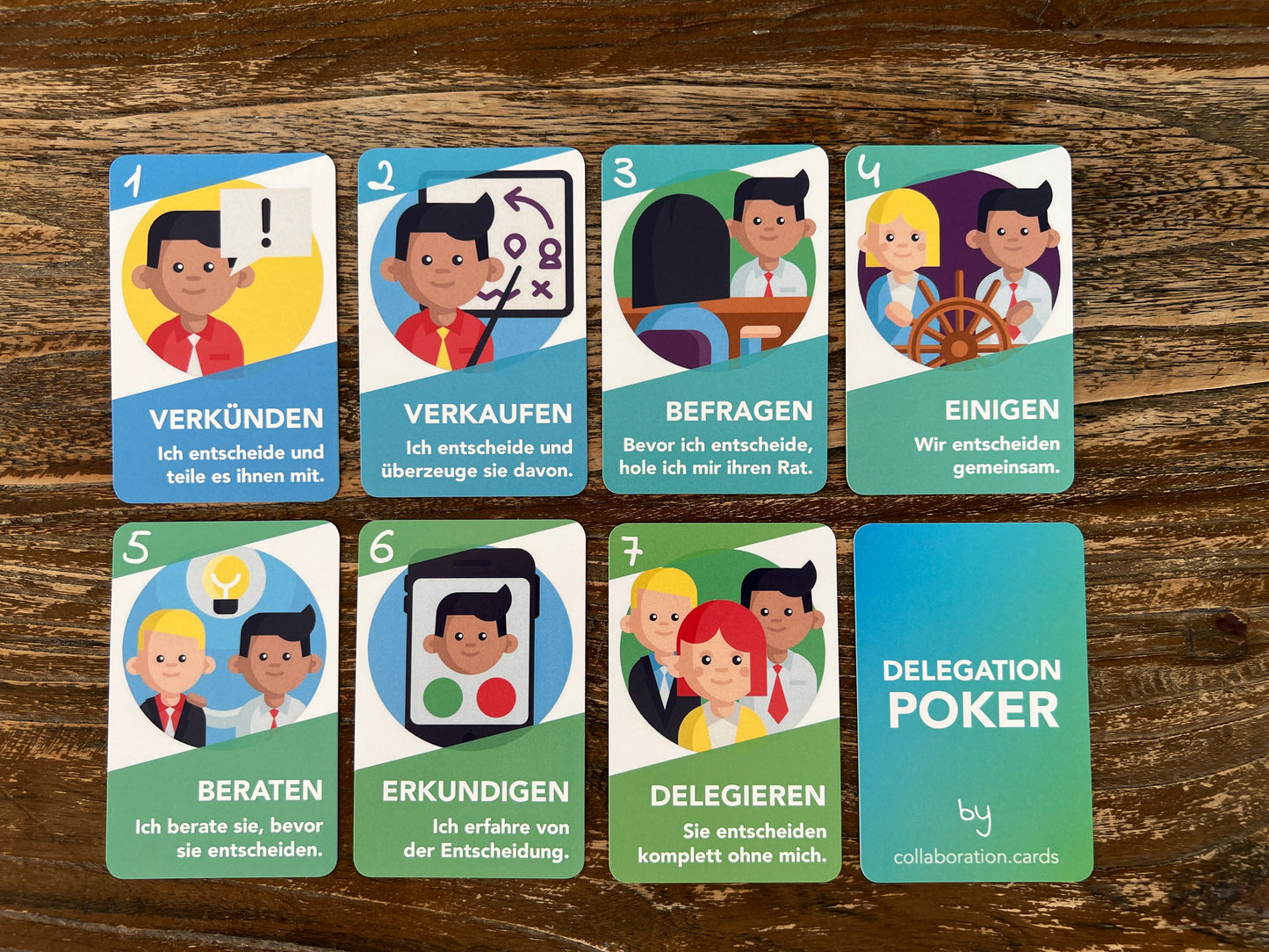
Here are the levels at a glance – supplemented with context, application scenarios, and impact:
-
Tell («Announce»)
Definition: You make the decision alone and inform the team – discussion undesired.
Application: Crisis situations, legal requirements, rapid strategic direction setting.
-
Sell («Persuade»)
Definition: You make the decision, but actively engage the team by explaining the decision and building acceptance.
Application: For major changes or when you need support – e.g., new working methods.
-
Consult («Consult»)
Definition: You gather input, analyze it, and then make the decision.
Application: For complex issues that require different perspectives – e.g., budget, resource decisions.
-
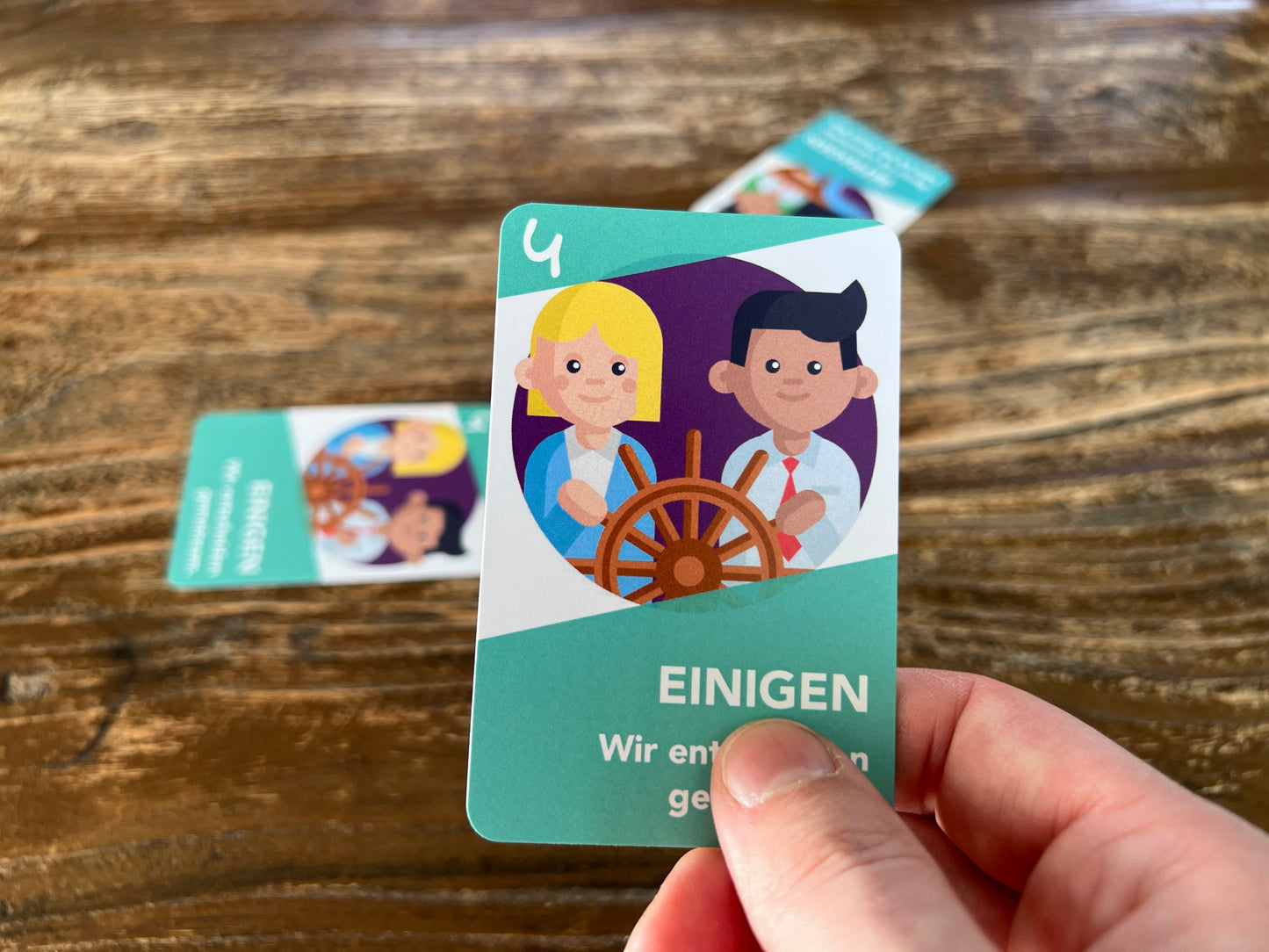
Agree («Agree»)
Definition: Decision by consensus – group dialogue.
Application: When commitment from everyone is required – e.g., for team rules, sprint structures.
-
Advise («Advise»)
Definition: You provide recommendations, share your expertise – the team decides independently.
Application: For experienced, competent teams, e.g., technical decisions, process design.
-
Inquire («Inquire»)
Definition: The team makes the decision and informs you afterward.
Application: For routine decisions that need to be made quickly and with low risk.
-
Delegate («Delegate»)
Definition: Full handover – decision rests with the team, no feedback necessary.
Application: In highly autonomous, self-organizing teams – e.g., for Daily Standups, tool selection.
These levels show a clear development model – from a directive approach to complete autonomy
4. Why This Model Is So Effective
The model of the 7 Levels of Delegation is not just a theoretical framework, but acts in practice as a powerful tool for modern leadership – for various reasons:
Clarity on Decision-Making Authority
Teams and leaders often have different expectations about who decides when. The model creates a common language and clear definitions – whether "Tell," "Sell," or "Delegate," each level clearly describes who has the final say. This framework reduces misunderstandings and ensures consistent transparency.
Building Trust through Structure
With each step up the levels model, the team's responsibility increases. This not only builds trust in the employees' abilities but also in the processes. Delegation is not seen as a loss of control, but as a targeted development process .
Adaptable to Team Maturity and Context
Not every situation is suitable for the highest level of delegation. Complex, high-risk decisions may still require "Tell" or "Sell." In less structured, more mature teams or for routine tasks, however, one can gradually move towards "Delegate." The levels thus offer a clear but flexible course of action .
Fosters Personal Responsibility and Motivation
When teams are increasingly empowered to make their own decisions, their motivation and identification with tasks increase. They feel taken seriously and empowered – which ultimately leads to better performance and stronger collaboration .
Efficiency through Appropriate Delegation
Delegating tasks frees up time for strategic work. At the same time, the team can act more effectively and quickly if it is empowered to make decisions independently – and knows within what framework it is allowed to operate.
5. Practical Application: How to Implement the Model
A) The Delegation Board as a Visual Tool
A Delegation Board is a matrix with decision fields on the vertical axis and Delegation Levels 1–7 on the horizontal. For each area (e.g., prioritization, budget, or team rules), the current delegation level is visibly marked – e.g., with sticky notes or digital notes. This provides an immediately understandable overview of where decision-making authority currently lies – and where development is possible .
B) Step-by-Step Approach to Implementation
-
Identify Decision Areas
Work together to identify relevant areas – e.g., technical architecture, moderation tools, working hours, or budget questions .
-
Determine Current Level
Discuss which delegation level each task currently falls under – an honest assessment is key.
-
Define Target Level
Where should the team grow (e.g., from "Consult" to "Advise" or even "Inquire")? These goals should be realistic and motivating.
-
Create Board
Visualize the results. A digital version (e.g., in Miro or Excel) is suitable for remote teams; physically, it can remain on display in the office .
-
Schedule Regular Reflection
Delegation is dynamic. Schedule regular reviews – e.g., during retrospectives every three months, to reflect on developments and adjust the board structure .
C) Additionally: Delegation Poker as an Introduction
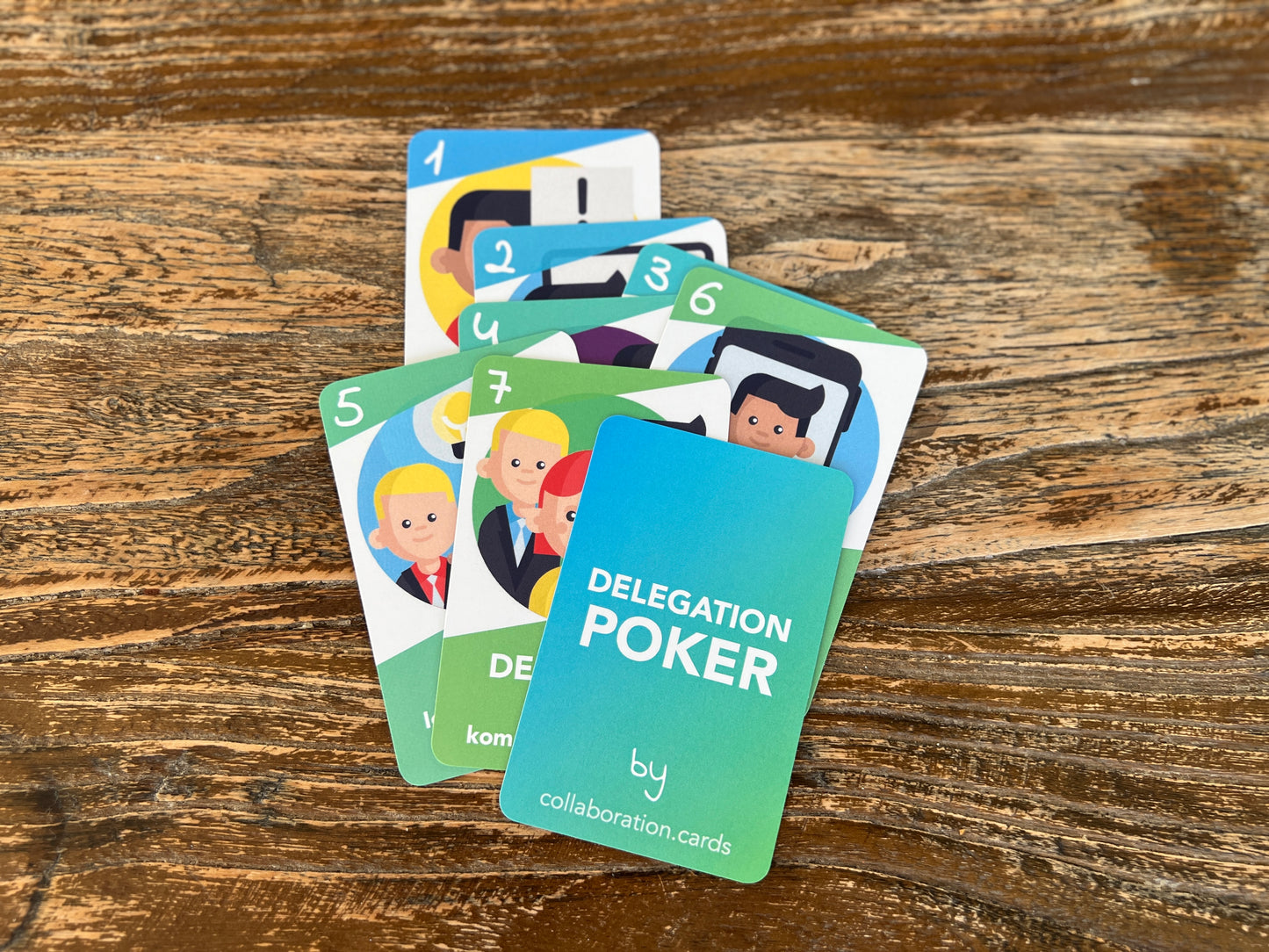
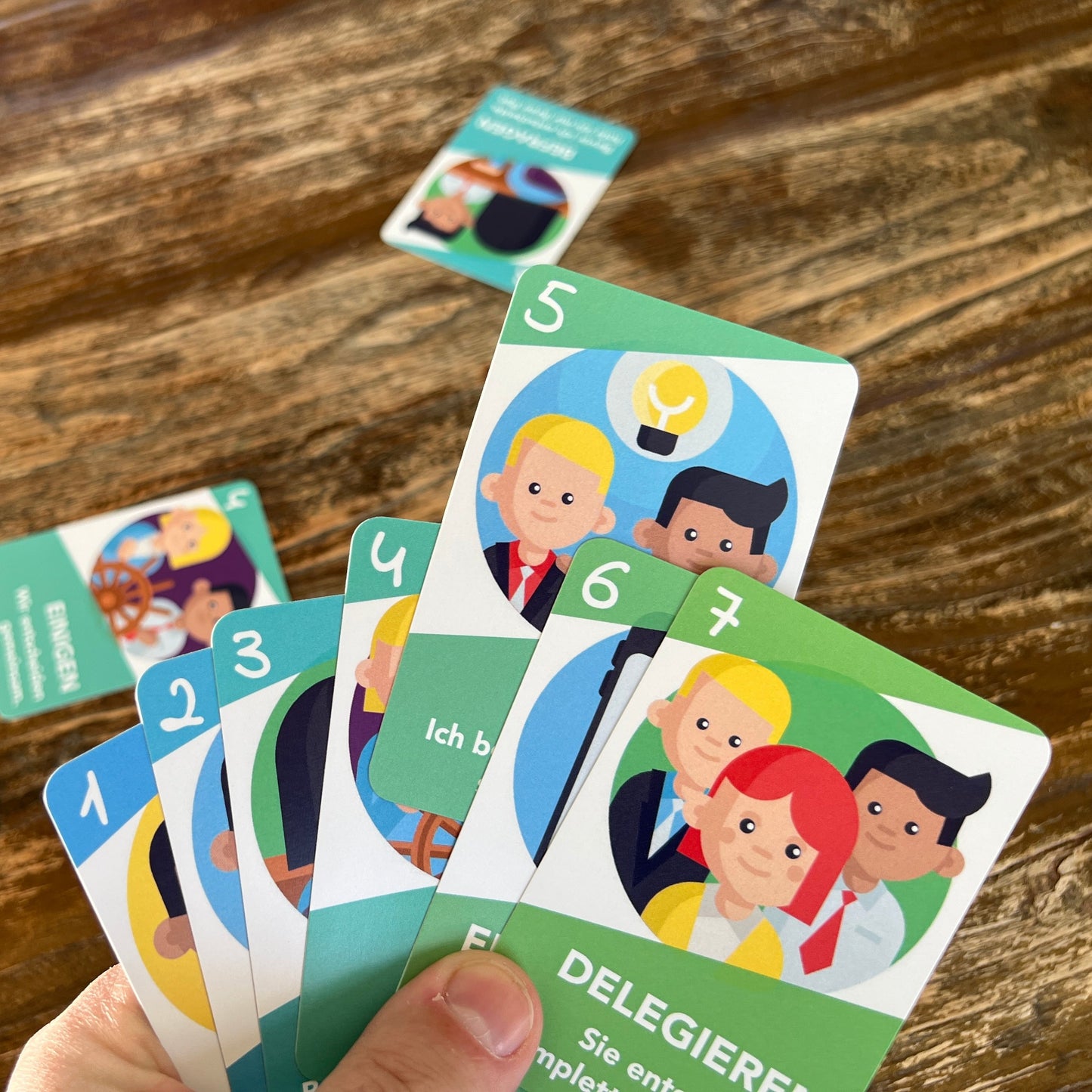
Delegation Poker is a playful approach to initiate discussions about appropriate delegation levels:
-
Each person receives cards from Level 1–7.
-
A scenario is presented (e.g., "Tool Selection").
-
Everyone secretly chooses a card.
-
Cards are revealed; extreme positions (highest/lowest participants) justify their choice.
-
Discussion until a common understanding or consensus is reached.
-
Afterward, this result is transferred to the Delegation Board .
This creative approach promotes understanding, participation, and collaborative decision-making – ideal for team workshops or retrospectives.
6. Example: Delegation Board for a Fictional Team
|
Decision Area |
Current (Example) |
Target (Example) |
|---|---|---|
|
Selection of Modular Tools |
Consult (3) |
Advise (5) |
|
Blog Content Topics |
Advise (5) |
Inquire (6) |
|
Budget for Workshops |
Sell (2) |
Consult (3) |
|
Working Hours Regulation |
Agree (4) |
Agree (4) |
|
Selection of Communication Tools |
Inquire (6) |
Delegate (7) |
Analysis:
-
For tool-related matters, influence is desired, but the team should increasingly be able to decide independently.
-
Blog content could be almost autonomously set, with occasional feedback.
-
Budget questions initially remain more controlled but with increasing trust.
-
Working hours are already regulated by consensus.
-
Communication tools can be fully delegated – high expertise is present in the team.
This creates a concrete roadmap to make delegation maturity transparent and to further advance it.
7. Tips for Successful Implementation
-
Create Transparency: Clearly communicate why certain levels were set. Open discussion prevents frustration and builds understanding.
-
Start Slowly: Delegating too much too quickly can be overwhelming. Introduce levels gradually – in small successes.
-
Consider Team Maturity: Especially with new or less experienced teams, it's better to start in the middle range.
-
Establish Feedback Loops: Delegation is not a "set-and-forget" tool. Regular reflection is crucial.
-
Ensure Documentation: The board should be accessible to everyone – physically or digitally, transparent and always available.
8. Conclusion: More Clarity, More Success through Structured Delegation
The 7 Levels of Delegation are not a rigid concept, but a dynamic guide for modern leadership and teamwork. They enable:
-
Clear areas of responsibility, without micromanagement.
-
Strengthening individual competencies, through clearly defined responsibility development.
-
Efficiency through independent decision-making, with trust and structured freedom.
Whether as an introduction via Delegation Poker or long-term with a visualized Delegation Board – both lead to a valuable, transparent dialogue within the team. You gain structure and clarity in leadership responsibility – while your team grows and increasingly makes its own decisions.
And to get started, feel free to try our Delegation Poker card set. You've never had so much fun making decisions.