Team Check-ins: How to Strengthen Trust, Connection & Psychological Safety
Share
Table of Contents
- Introduction
- Why Check-Ins Are So Effective
- Using Check-Ins Correctly: Structure and Unlocking Their Impact
- Impact in Practice: Check-Ins in Everyday Life
- Common Concerns & Practical Solutions
- A Scientific Look: Why Check-Ins Truly Work
- Conclusion
1. Introduction
Check-ins are much more than just a quick exchange at the start of a meeting. They are a precise tool to deliberately strengthen trust, psychological safety, and team bonding—especially in hybrid or remote teams. The question "How are you doing today?" or prompts like "What excites you this week?" seem simple at first glance, but they have a lasting impact: they open up personal spaces, encourage genuine listening, and set an appreciative tone.
In this article, we will show you step-by-step why regular check-ins are essential, how to implement them in a structured way, what effects result from them, and how to develop an employee culture that remains human—even digitally. Inspiration is provided by insights from the Harvard Business Review, Gallup studies, Mural, Quantum Workplace, and other sources that prove: As simple as the start, as profound as the effect.
2. Why Check-Ins Are So Effective
2.1 Fostering Trust and Psychological Safety
Regular check-ins enable conversations where employees can share their feelings, thoughts, or roadblocks without fear. This creates an atmosphere of openness where people feel seen and respected. This collective trust—also known as psychological safety—is a crucial factor for innovation and team performance .
2.2 Transparency, Honesty, and Emotional Understanding
Check-ins make it possible to make feelings and needs visible—for example, through simple questions like "What's on your mind right now?" or "How are you doing today?" This form of openness prevents misunderstandings and strengthens mutual understanding .
2.3 More Participation – Everyone in the Room, Everyone Heard
Through check-ins, every team member is equally involved in the exchange—from interns to leaders. This ensures presence, promotes a democratic conversation culture, and signals: "You are part of something bigger." .
2.4 Mood Monitoring Over Time
When check-ins are conducted regularly—for example, with scales like "1 = energetic" to "5 = tired"—an emotional mood picture emerges that shows trends. This allows teams to identify mood swings and counteract them before they escalate .
2.5 Increasing Engagement and Productivity
Studies show that employees whose leaders regularly engage in conversations are up to seven times more engaged, while those who feel ignored are 15 times more likely to be actively disengaged . Furthermore, PerformYard and other sources confirm: Regular conversations prevent missteps and increase overall performance .
2.6 Early Problem Detection & Strengthening Accountability
Check-ins help to identify challenges or ambiguities early on—whether in a project or personally. This creates space for encouragement, feedback, and adaptation. Moreover, confirmation increases the team's sense of responsibility .
3. Using Check-Ins Correctly: Structure and Unlocking Their Impact
A) Formats & Settings
Check-ins unfold their impact when used deliberately in different settings. In synchronous team meetings, they serve as an emotional and mental "anchor" at the beginning – questions like "How are you doing today?" or "What's on your mind right now?" help to create focus and enable genuine presence. Facilitator Kristin Cobble emphasizes in Time that such introductions not only reduce distractions but also foster authentic listening – an essential step in times when digital distractions dominate everyday life.
In parallel, regular one-on-one conversations offer a significantly more in-depth framework. Here, emotional states can be reflected upon, as well as challenges, goals, or personal developments. Studies show that this personal attention builds trust and intensely strengthens employees' sense of responsibility.
For decentralized or hybrid teams, asynchronous formats are also suitable – for example, via chat, digital boards, or short pulse questions. These fulfill an important function: even those who operate in the background get a voice and can feel seen and connected. This creates closeness and participation despite physical distance.
B) Frequency & Duration
The question of the frequency and length of check-ins largely determines their sustainability. What is crucial is not so much the duration, but the reliability. Short, daily check-ins are already highly effective – they offer space for emotional grounding before the substantive work begins. The Harvard Business Review shows: employees are more engaged when leaders regularly seek connection – even if it's just short check-ins .
In weekly one-on-one sessions, however, experts recommend an initial phase of five to ten minutes for personal orientation – sufficient time to continue working productively based on emotional context. According to Bonusly, it makes sense to plan weekly meetings of around 30 minutes, especially for younger or new employees; for experienced employees, a slightly longer conversation every two weeks is often sufficient .
In addition, regular check-ins can be used to develop an "emotional mood picture" of the team – for example, visualized via a scale or panel – with the aim of identifying trends early and, if necessary, counteracting them. Studies show that teams with regular exchange show significantly higher motivation and satisfaction; conversely, a lack of communication significantly increases the risk of demotivation .
C) Questions & Variety
Diversity in questioning is crucial to keep check-ins lively. Emotionally oriented questions ("How are you feeling right now?") create immediate connection. Reflective questions like "What was your highlight of the week?" promote emotional exchange. Future-oriented impulses like "What are you looking forward to?" provide momentum. And metaphor questions ("What color describes your mood?") inspire creativity and self-awareness. By regularly changing topics, the format remains inspiring and avoids fatigue – a recipe for lasting impact.
D) Atmosphere & Moderation
The entry by leaders in an open role is a signal of trust and authenticity – when leaders share honestly first, employees are more likely to follow. However, check-ins should not be a platform for evaluation: silence is allowed, answers do not need to be discussed or judged. This attitude creates a "safe space," which psychology and organizational research define as the basis for innovation and team development .
Such open attitudes avoid coercion. Instead, an atmosphere is created in which participants can actively contribute – one of the essential foundations of modern work culture.
E) Documentation & Reflection
Check-ins should not fade away, but serve as an impulse and be documented. A mood or topic documentation – e.g., as a weekly mood curve – makes developments visible, helps identify stress, and celebrate successes. In retrospective sessions, patterns can be derived from this: Which phases are stressful, when does the team flourish? Thus, a check-in is not just a ritual, but becomes a learning companion – promoting people, mood, and performance .
4. Impact in Practice: Check-Ins in Everyday Life
Remote Team of a Tech Company
A sprint-start check-in: "What's on your mind right now?" brought surprisingly personal and project-related insights – empathy and planning noticeably benefited.
Hybrid Workshop in the Agency
Participants described their mood with one word – e.g., "exuberant," "focused," "unexpectedly calm." Immediate feedback enabled moderation that took into account the emotional tone of the room.
Leadership 1:1 Meetings
Starting with questions like "What went well, where do you need support?" encouraged more honest conversations and reduced surprises during the project.
Onboarding New Employees
On the first day, questions like "What is currently important to you?" were asked – making it quickly apparent what truly matters and fostering early personal connections.
5. Common Concerns & Practical Solutions
|
Concern |
Suggested Solution |
|---|---|
|
"That's too personal." |
Start with abstract scales or neutral topics. |
|
"It takes too much time." |
Keep it short (max. 3 minutes). The benefit compensates for this small effort. |
|
"Introverts will hold back." |
Offer written or anonymous options – chat or online tools help. |
|
"Routine becomes boring." |
Regularly introduce new questions, be creative. |
|
"The effect wears off." |
Anchor reflection and adaptation within the team. |
6. A Scientific Look: Why Check-Ins Truly Work
Psychological Safety
Teams with high psychological safety support openness, innovation, and performance – and check-ins foster this environment .
More direct data confirms: In virtual teams, check-ins strengthen trust, problem-solving, and communication .
Effectiveness & Inclusivity in Meetings
Studies show: Good preparation (agenda, clear process), technical setup, and inclusive measures increase meeting quality – and check-ins are a central component of this .
Early Detection of Mental Stress
Check-ins make mood and stress visible – early intervention prevents burnout or demotivation in the team .
Trust as the Foundation for Productivity
Remote employees with a high level of trust show greater focus, motivation, and satisfaction .
7. Conclusion: Check-Ins – Simple Yet Powerful
Check-ins are not a nice extra – they are essential for a good team culture. They promote:
-
Trust & Safety
-
Transparent Communication
-
Emotional Connection in Hybrid Settings
-
Early Addressing of Stress
-
Higher Productivity and Satisfaction
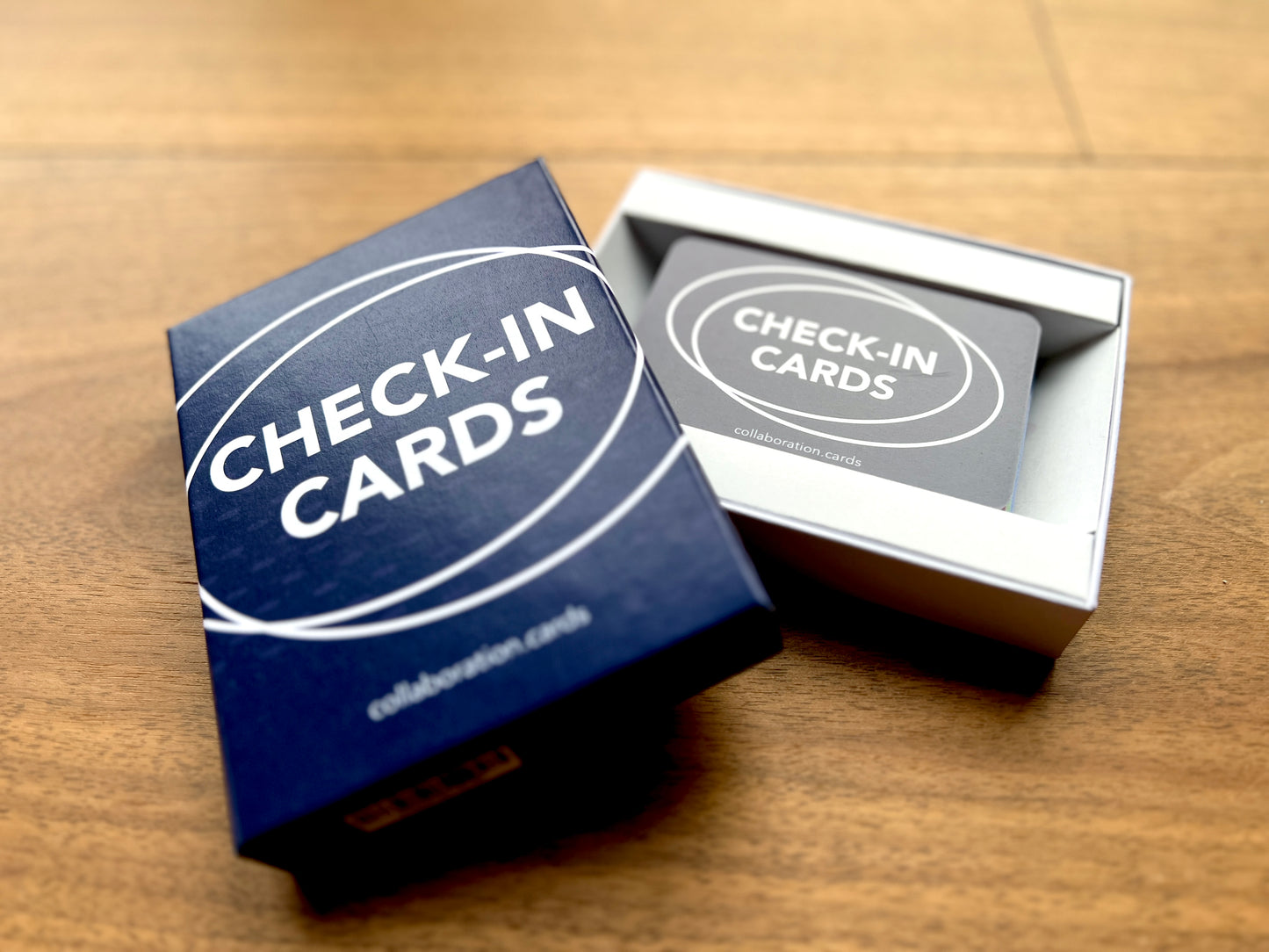
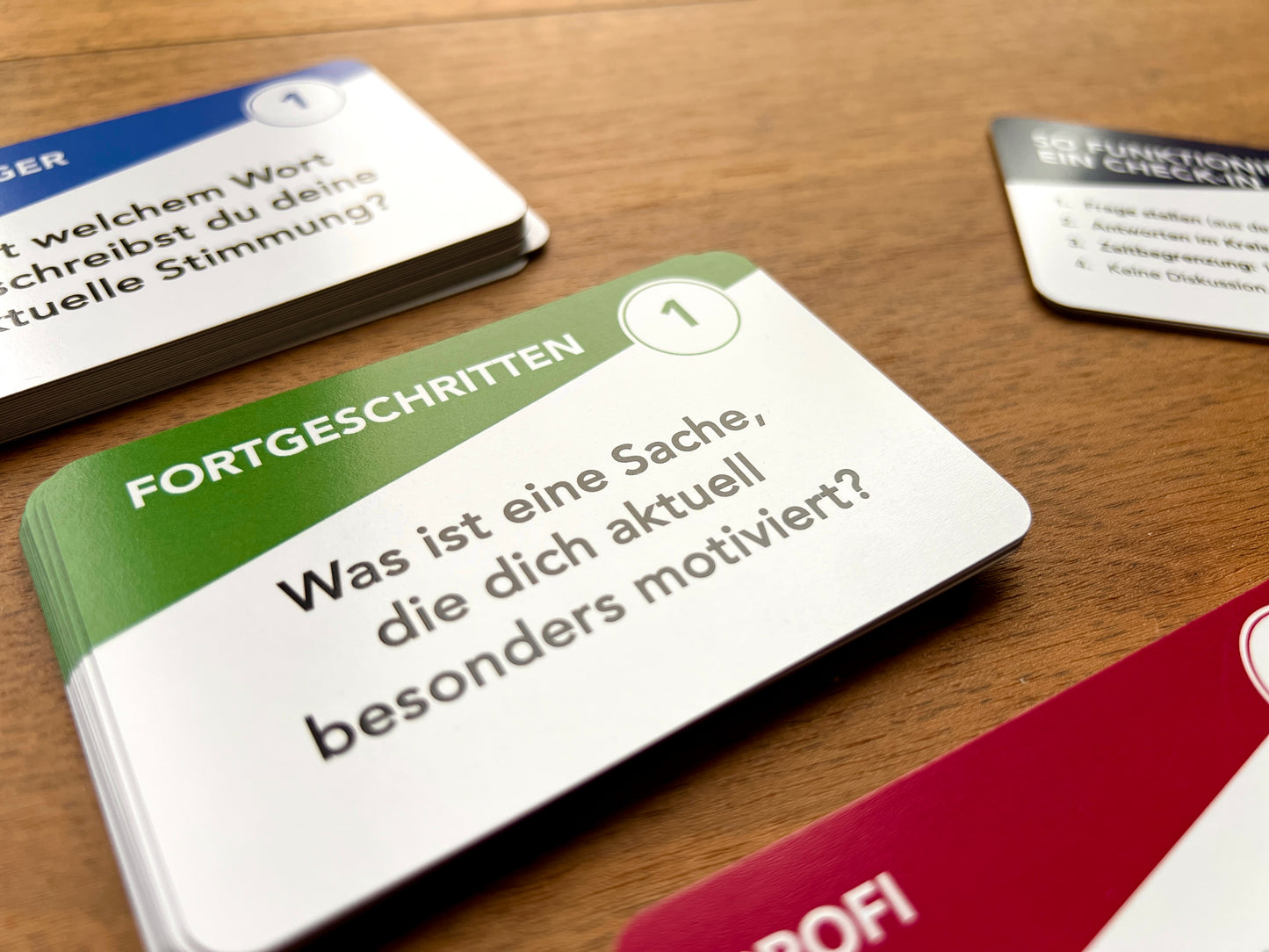
Deliberately embed check-ins in your team – in meetings, in daily life, or in one-on-ones. Use our intuitive Check-In Cards to always have a suitable question ready.